

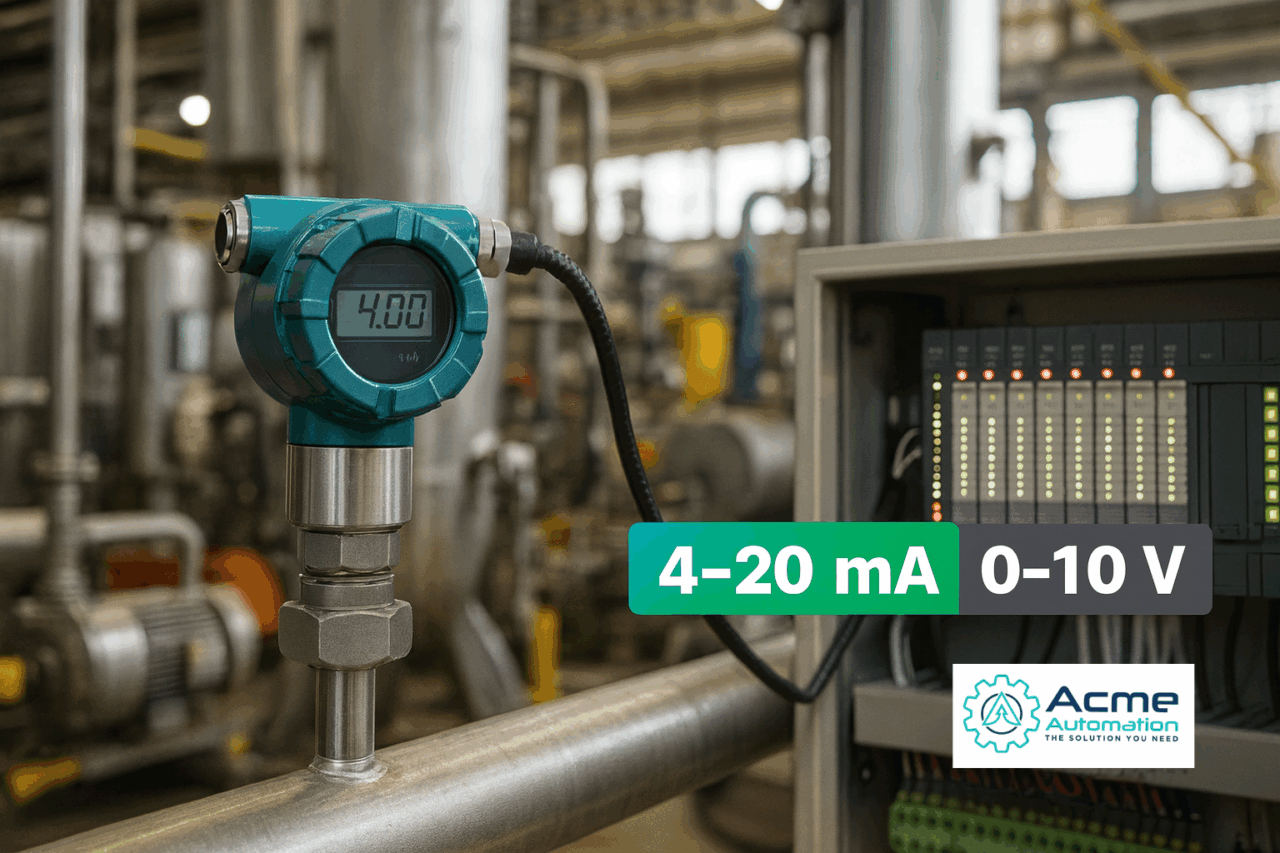
The Hidden Engineering Logic Behind Industrial Signal Standards
In the world of industrial automation and process instrumentation, accurate and noise-free communication between field sensors and controllers is vital. Whether it’s temperature, pressure, level, flow, humidity, or vibration — every measurement must reach the PLC, DCS, or SCADA system reliably. But have you ever wondered why the industry universally uses 4–20 mA analog signal transmission instead of 0–10V?
The preference is not random. The 4–20 mA current loop became the global standard because it offers precision, reliability, safety, and long-distance performance — all essential in harsh industrial environments.
🔧 Voltage vs. Current Signal — What’s the Difference?
Before diving deeper, let’s understand the key distinction:
| Parameter | 4–20 mA Current Signal | 0–10V Voltage Signal |
| Susceptibility to noise | Very low | High |
| Wiring distance | Long | Short |
| Voltage drop impact | No | Yes |
| Fault detection | Easy (below 4 mA) | Difficult |
| Powering field devices | Possible | Not possible |
Although voltage signals like 0–10V are common in laboratories or HVAC systems, they are not ideal for tough industrial environments.
⚙️ Reasons Why Industrial Sensors Prefer 4–20 mA Over 0–10V
⭐ 1. Immune to Electrical Noise & Signal Loss
Factories are filled with VFD drives, motors, welding arcs, heavy machinery, conveyors, induction heaters and power cables, all of which generate electromagnetic noise.
A current signal is not affected by electrical interference, while voltage signals may fluctuate and distort based on cable resistance and induced noise.
➡️ Result: 4–20 mA guarantees stable readings even in noisy environments.
⭐ 2. No Accuracy Loss Over Long Cable Runs
In large industrial plants like refineries, chemical plants, cement plants, water treatment plants, food & beverage factories, sensors can be hundreds of meters away from the control room.
Current does not drop with cable length, whereas voltage suffers a drop across resistance.
➡️ With 4–20 mA, the value received at the PLC is the exact value sent by the sensor.
⭐ 3. Built-In Fault Detection
The brilliant engineering logic behind starting the scale at 4 mA instead of 0 mA:
- 4 mA = 0% process reading
- 20 mA = 100% process reading
- Below 3.8 mA = malfunction / cable break / power supply failure
With 0–10V:
- 0V = 0% reading
- But also 0V when there is a fault — impossible to differentiate
➡️ With 4–20 mA, operators and SCADA systems can immediately detect a failure, improving safety and uptime.
⭐ 4. Enables Loop-Powered Systems (Two-Wire Sensors)
One of the biggest advantages:
A 4–20 mA loop can power the sensor itself, eliminating the need for a separate power supply.
This reduces:
✔ wiring cost
✔ installation complexity
✔ control panel space
➡️ Highly valuable for field instruments like transmitters, flowmeters, and level sensors.
⭐ 5. Higher Accuracy and Signal Resolution
In 0–10V systems, small fluctuations of millivolts can distort readings.
4–20 mA supports very precise measurement and high resolution, especially when interfacing with:
- PLC analog cards (AI)
- DCS controllers
- SCADA historian databases
➡️ Better precision means better process control, energy efficiency and production quality.
🚫 So Why Is 0–10V Still Used Sometimes?
Although 4–20 mA dominates heavy industry, 0–10V signals are still used in:
- Building automation (HVAC)
- Low-noise lab applications
- Small machine control panels
Reason?
Voltage-based systems are cheaper and wiring distances are shorter — but not designed for harsh industrial conditions.
🏁 Final Verdict
| Application | Best Choice |
| Small commercial / HVAC | 0–10V |
| Heavy industrial automation | 4–20 mA |
| Long wiring distance | 4–20 mA |
| Safety-critical processes | 4–20 mA |
| High EMI / noise environment | 4–20 mA |
➡️ That’s why 4–20 mA remains the global standard in industrial plants and automation projects.
🔍 Where 4–20 mA Is Typically Used
4–20 mA sensors and transmitters are widely used in:
- Thermic fluid heaters
- Boilers & steam plants
- Concrete batching plants
- Water & wastewater treatment plants
- Distilleries and pharma plants
- Food & beverages industry
- Oil & gas and chemical plants
- Material handling and crushers
- Packaging and printing machines
Wherever precision, reliability and safety matter — 4–20 mA wins.
📞 Looking for Reliable Sensor & Automation Panel Integrations?
Whether your plant requires PLC–SCADA integration, field sensor connectivity, MCC panels, VFD panels or complete automation upgrades, ACME Automation delivers reliable, industry-standard solutions with 4–20 mA instrumentation compatibility.
📧 sales@acmeautomation.in
📞 +91 97277 56069
🌐 www.acmeautomation.in