

Introduction
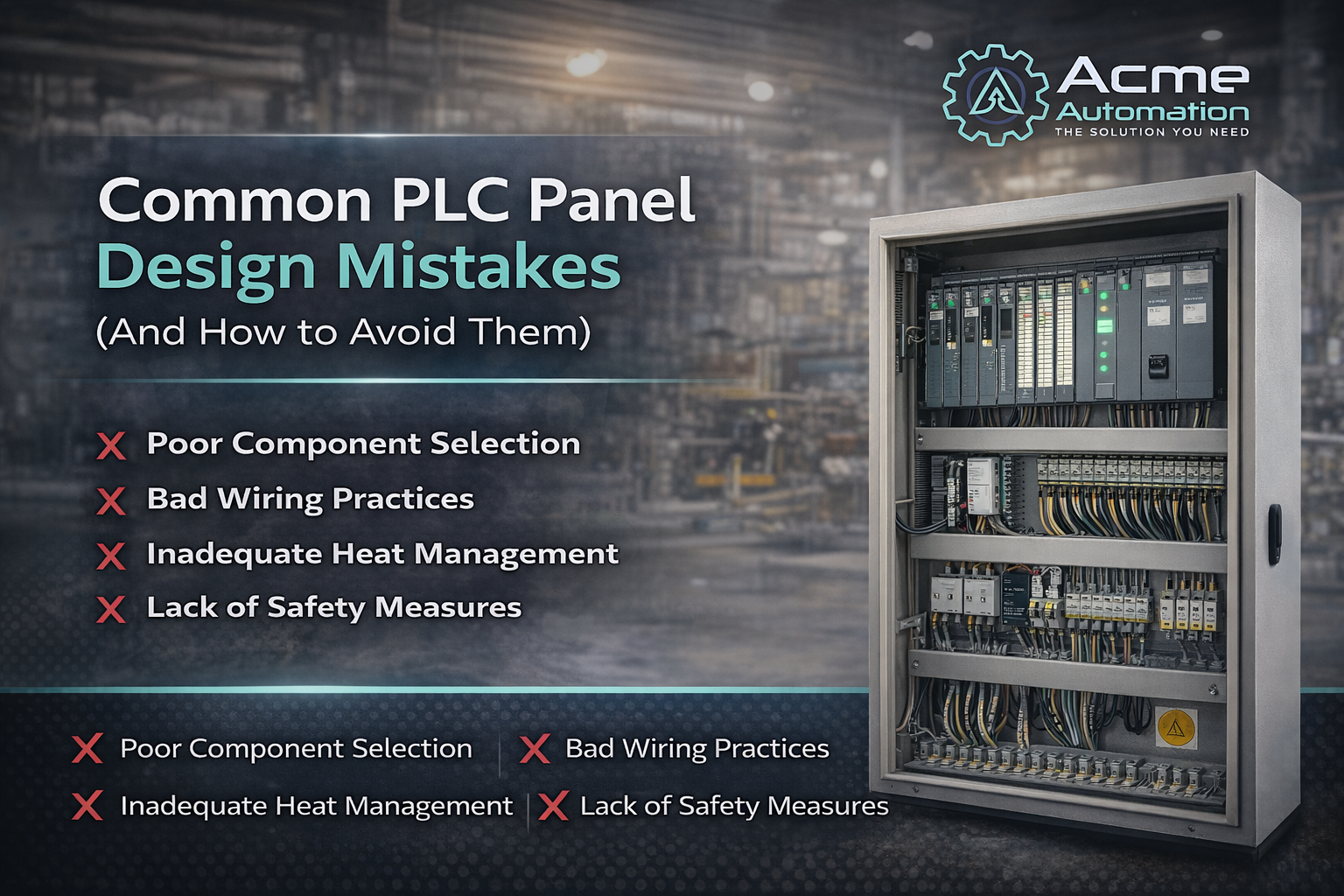
A PLC control panel is the brain of any industrial automation system. Whether it is used in water treatment plants, chemical industries, crushers, food & beverage units, or manufacturing plants, a well-designed PLC panel ensures safe, reliable, and efficient operation. However, many industries face frequent breakdowns, downtime, and safety risks due to poor PLC panel design.
In this blog, we discuss the most common PLC panel design mistakes seen in industrial projects—and more importantly—how to avoid them through proper engineering, standards, and best practices.
1. Poor Component Selection
The Mistake
Using low-quality or incompatible components is one of the biggest mistakes in PLC panel design. This includes:
- Underrated MCBs, contactors, and power supplies
- Non-industrial-grade PLCs and I/O modules
- Cheap terminals and relays
Such components may work initially but fail under real industrial conditions like heat, dust, vibration, and electrical noise.
How to Avoid It
- Use reputed brands (Siemens, Schneider, ABB, Allen-Bradley, etc.)
- Select components based on load calculations and environment
- Follow IEC and industrial standards
At ACME Automation, every PLC panel is designed using application-specific, industry-approved components.
2. Inadequate Heat Management
The Mistake
Many PLC panels fail prematurely due to overheating. Common causes include:
- No panel ventilation or cooling
- Overcrowded panels
- Ignoring ambient temperature
Excess heat reduces PLC life and leads to unpredictable failures.
How to Avoid It
- Perform proper heat load calculations
- Use panel fans, exhaust filters, or air conditioners when required
- Maintain adequate spacing between components
A well-planned thermal design ensures long-term reliability of automation panels.
3. Poor Cable Management & Wiring Practices
The Mistake
Messy wiring is not just an aesthetic issue—it leads to:
- Signal interference
- Troubleshooting difficulties
- Increased risk of short circuits
Mixing power cables with control and signal wiring is a common error.
How to Avoid It
- Use separate cable ducts for power and control wiring
- Follow proper wire numbering and ferruling
- Maintain neat cable routing and adequate bending radius
Professional wiring improves safety, diagnostics, and future modifications.
4. Ignoring Electrical Noise & EMI Protection
The Mistake
PLC panels installed near VFDs, motors, and heavy machinery are exposed to electrical noise and EMI. Ignoring this can cause:
- False PLC inputs
- Communication failures
- System instability
How to Avoid It
- Use shielded cables for analog and communication signals
- Proper grounding and earthing
- Install EMI filters and surge protection devices
Correct EMC practices are critical for reliable automation performance.
5. Improper Power Supply Design
The Mistake
Using a single power supply without redundancy or protection often leads to total system shutdown during voltage fluctuations.
How to Avoid It
- Use industrial-grade SMPS with overload protection
- Provide redundancy for critical PLC systems
- Separate control and power circuits
Stable power supply design ensures uninterrupted operation.
6. Lack of Safety Considerations
The Mistake
Ignoring safety standards in PLC panel design can result in:
- Electrical hazards
- Non-compliance with regulations
- Risk to operators and equipment
Common mistakes include missing interlocks, emergency stops, and protection devices.
How to Avoid It
- Follow IEC / IS safety standards
- Include emergency stop circuits and safety relays
- Design panels with clear labeling and lockable doors
Safety should never be compromised in industrial automation panels.
7. Poor Future Scalability Planning
The Mistake
Designing a PLC panel only for current requirements leaves no room for future expansion. This leads to:
- Costly panel modifications
- Limited I/O availability
- Reduced flexibility
How to Avoid It
- Provide spare I/O points
- Allow space for future components
- Use modular PLC architecture
Scalable PLC panel design saves time and cost in the long run.
8. Incomplete Documentation & Labeling
The Mistake
Many panels are delivered without proper drawings or documentation, making maintenance difficult.
How to Avoid It
- Provide updated electrical drawings
- Label all components, terminals, and cables
- Include PLC I/O lists and manuals
Complete documentation ensures easy maintenance and troubleshooting.
9. Ignoring Environmental Conditions
The Mistake
Installing standard panels in harsh environments such as dusty crushers, humid water plants, or chemical atmospheres without protection leads to early failures.
How to Avoid It
- Select appropriate IP-rated enclosures
- Use anti-corrosion components where required
- Consider site-specific conditions during design
Customized PLC panels perform better than generic solutions.
Why Proper PLC Panel Design Matters
Avoiding these common mistakes results in:
- Reduced downtime
- Improved safety
- Longer panel life
- Easier maintenance
- Higher productivity
A professionally designed PLC panel is an investment, not a cost.
Why Choose ACME Automation?
ACME Automation is a trusted PLC panel builder and industrial automation solution provider offering:
- Customized PLC control panels
- MCC, VFD, and SCADA panels
- Industry-specific automation solutions
- Compliance with international standards
- Reliable after-sales support
We design panels that are safe, scalable, and future-ready.
Conclusion
PLC panel design mistakes can lead to serious operational and financial losses. By following proper engineering practices, selecting the right components, and partnering with an experienced automation company, these issues can be easily avoided.
With ACME Automation, you get expertly designed PLC panels that deliver reliability, efficiency, and long-term value.
Contact ACME Automation Today
📧 Email: sales@acmeautomation.in
📞 Phone: +91 97279 97049
🌐 Website: www.acmeautomation.in
ACME Automation – The Solution You Need.