

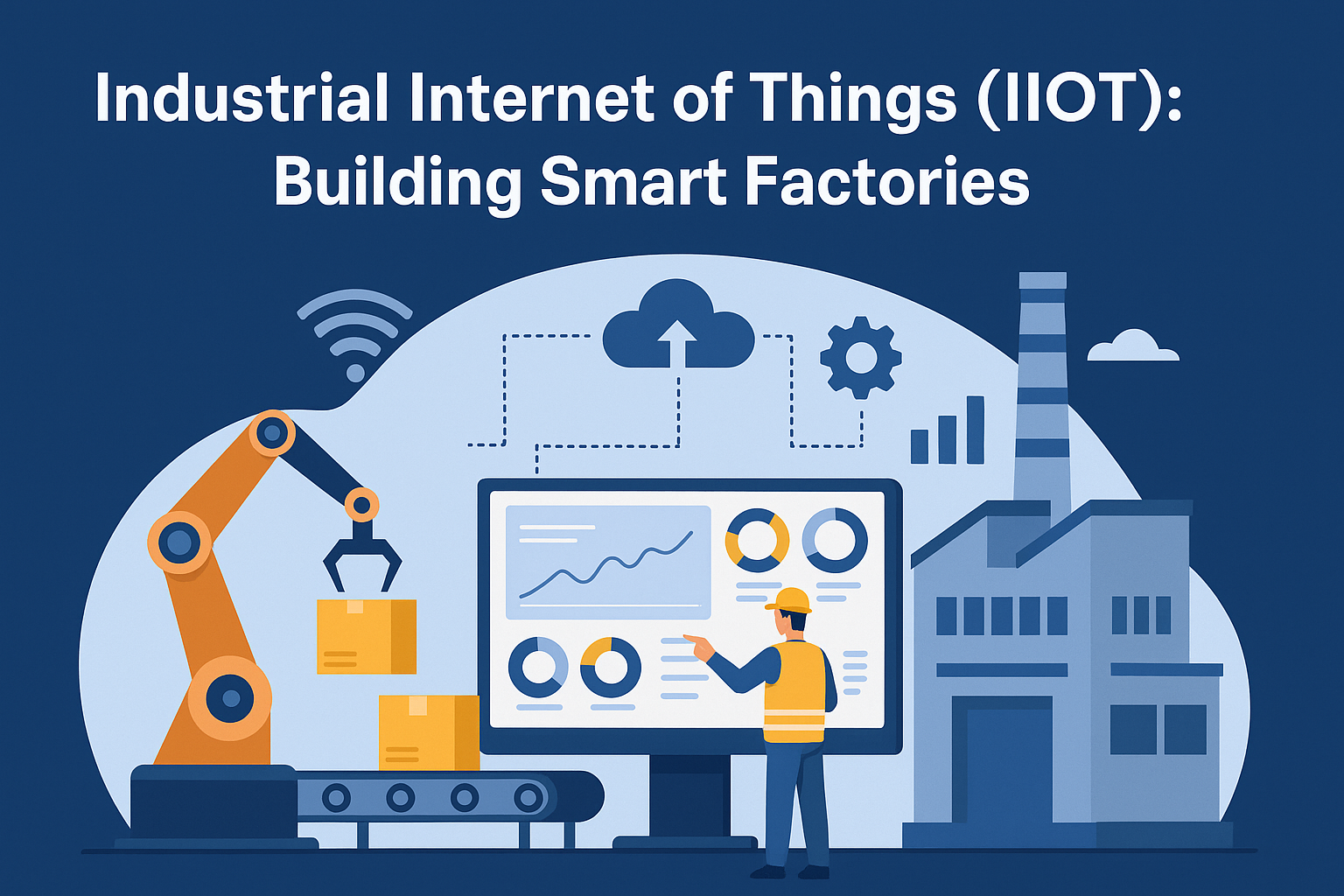
The manufacturing industry is undergoing a massive transformation. From manual processes to fully connected ecosystems, the Industrial Internet of Things (IIoT) is at the core of this change. By enabling connected automation solutions, IIoT helps factories achieve real-time insights, predictive maintenance, and seamless scalability — ultimately paving the way for smart factories.
In this blog, we will explore the role of IIoT in manufacturing, the benefits it delivers, practical applications, and how SCADA dashboards and one-click reporting are redefining efficiency in industrial operations.
What is IIoT in Manufacturing?
The Industrial Internet of Things (IIoT) refers to the integration of sensors, devices, machinery, and software systems into a connected network that communicates in real-time. Unlike traditional automation that only focused on task execution, IIoT in manufacturing allows data to flow seamlessly between machines, operators, and business systems.
This makes production lines intelligent and adaptive — capable of predicting faults, optimizing energy usage, and reducing downtime without human intervention.
Key Benefits of IIoT in Smart Factories
- Real-Time Monitoring
IIoT enables operators to monitor machines, production cycles, and energy consumption continuously through SCADA dashboards. Any deviation from the standard can be detected instantly. - Predictive Maintenance
Instead of waiting for equipment breakdowns, connected automation solutions provide predictive alerts. This reduces maintenance costs and avoids expensive downtimes. - Enhanced Productivity
Smart machines share live data, allowing manufacturers to balance workloads, minimize idle time, and speed up decision-making. - One-Click Reporting
With automated reporting systems, complex production data can be transformed into customized, one-click reports. Managers get accurate insights for quick analysis and compliance documentation. - Energy Optimization
IIoT devices help identify power-hungry machines and optimize load distribution, leading to reduced energy costs — a crucial aspect for sustainability goals.
Practical Applications of IIoT in Manufacturing
1. Connected Production Lines
Every motor, drive, and sensor can communicate with a central SCADA system. This enables streamlined processes and transparent monitoring across the plant.
2. Quality Control Automation
IIoT ensures continuous tracking of quality parameters such as pressure, temperature, and speed. Defective batches are flagged early, saving time and resources.
3. Remote Factory Management
Factory supervisors can access SCADA dashboards from anywhere — even on mobile devices — to check production status or initiate corrective actions remotely.
4. Smart Warehousing
IIoT sensors track inventory levels and synchronize with ERP systems. This reduces overstocking and ensures just-in-time supply for production.
5. Compliance & Audit Readiness
Reporting in one click provides regulatory bodies with precise data logs, ensuring factories remain compliant with international standards such as ISO, FDA, or GMP.
IIoT and the Role of SCADA Dashboards
At the heart of IIoT in manufacturing lies SCADA (Supervisory Control and Data Acquisition). Modern SCADA systems integrate seamlessly with IIoT devices, offering:
- Custom dashboards with visual KPIs (Key Performance Indicators).
- Historical data tracking for root-cause analysis.
- Mobile-friendly interfaces for decision-makers on the go.
- Automated alarms and alerts when thresholds are exceeded.
This empowers industries to operate smarter, faster, and more efficiently.
IIoT in Action: Examples Across Industries
- Pharmaceutical Plants: Achieve precision in batch monitoring, serialization, and compliance through connected devices.
- Food & Beverage Factories: Real-time monitoring of hygiene, temperature, and packaging for consistent quality.
- Water Treatment Plants: Remote monitoring and reporting of flow, chemical dosing, and energy consumption.
- Chemical Industries: Tracking pressure and chemical mixing processes to avoid hazards and ensure plant safety.
- Mining & Crushers: Monitoring conveyor loads, energy usage, and equipment wear to avoid breakdowns.
The Road Ahead: Building Smart Factories with IIoT
The future of manufacturing belongs to smart factories powered by IIoT, AI, and cloud-based automation. By investing in connected automation solutions, companies can achieve greater flexibility, reduce costs, and maintain global competitiveness.
With continuous innovation, IIoT is not just about connecting machines — it’s about connecting intelligence, efficiency, and sustainability into every corner of the factory floor.
Why Partner with ACME Automation?
At ACME Automation, we specialize in designing IIoT-enabled panels, SCADA dashboards, and connected automation solutions tailored for industries such as pharmaceuticals, food & beverages, chemicals, water treatment, and heavy engineering.
Whether it’s customized reporting in one click, real-time monitoring, or complete smart factory solutions — we bring global expertise with trusted technology partners to make your digital transformation journey seamless.
Contact ACME Automation Today
📧 sales@acmeautomation.in
📞 +91 97279 97049
🌐 www.acmeautomation.in